
Why is my lawn dying after summer in Arizona?
Most post-summer lawn failures in Arizona come from problems the heat exposes rather than creates: salt buildup from groundwater irrigation, sprinkler coverage gaps, compacted soil, thatch, shade, mowing too low, and pests such as bermudagrass mites or white grubs. The shape and location of the damage usually point to the cause.
Why did my grass die over the summer even though I watered it?
Frequent, shallow watering keeps roots in the top few inches of soil and leaves salt concentrated where the roots are. When days stay above 110°F and nights stay above 90°F, a shallow-rooted lawn cannot keep up. Deep, infrequent watering that reaches 6 to 8 inches builds roots that survive the heat.
Is my Bermuda grass dead or dormant after summer?
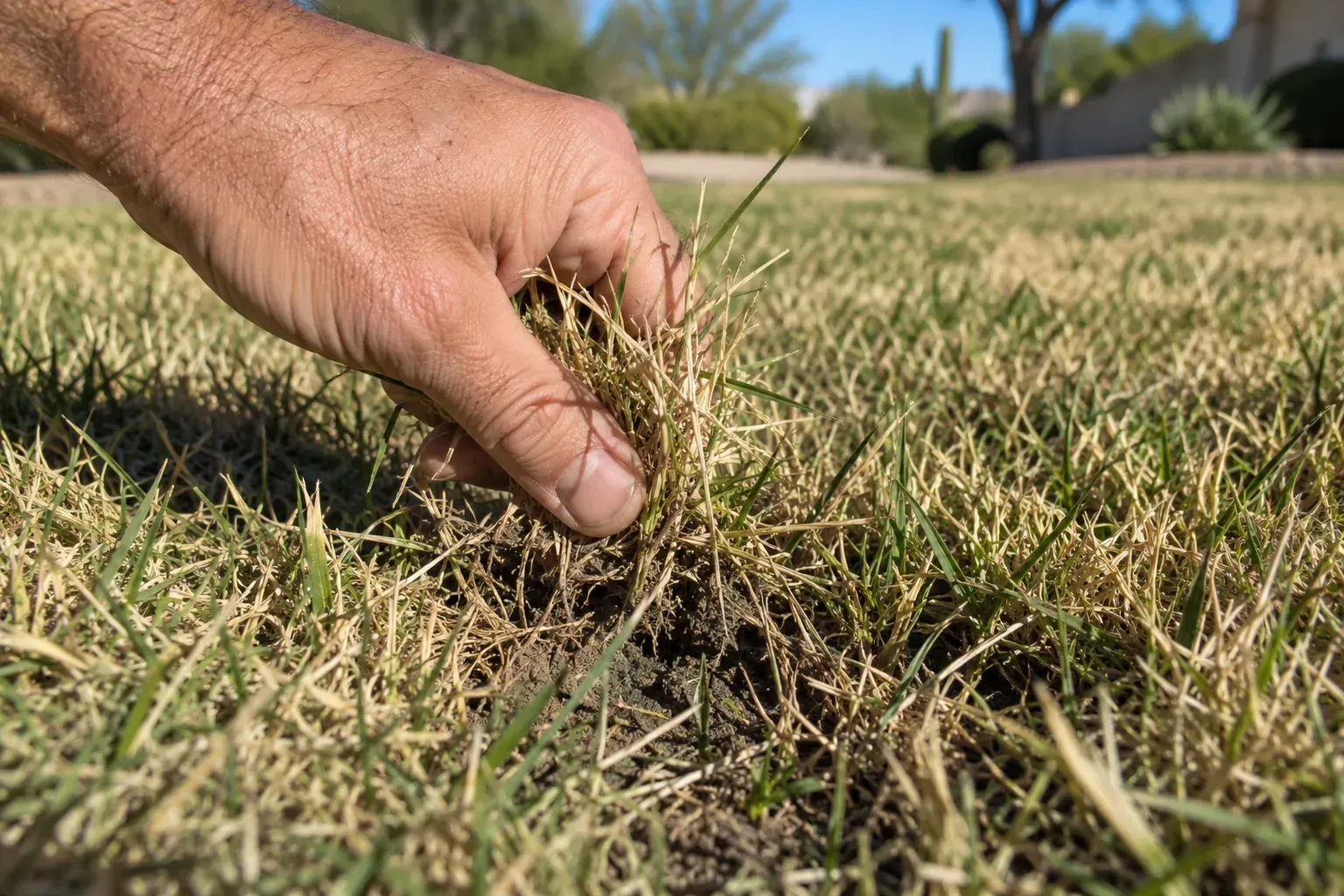
Grab a handful and pull. If it resists, the roots are alive and the grass is dormant or stressed. If it lifts like loose carpet, that section is dead or grubs have eaten the roots. Living Bermuda usually greens up within 2 to 4 weeks of consistent, deep watering.
How do I know if salt is killing my lawn?
Salt damage shows up as brown or thin areas that do not improve with extra water, sometimes with a white crust on bare soil. It is common in Buckeye, where water comes almost entirely from groundwater with naturally dissolved minerals. A soil salinity test confirms it, and deep, infrequent watering plus a winter flush pushes the salt below the root zone.
Can I aerate my Arizona lawn in the fall?
For Bermuda lawns in the low desert, fall is the wrong time for heavy aeration or dethatching. University of Arizona Extension identifies June, July, and August as the ideal window, when Bermuda is growing fastest and recovers quickly. Heavy work in September or October stresses grass that is heading into dormancy.
Why does my lawn die in the same spots every year?
Repeat failures in the same place almost always have a fixed cause: a sprinkler head that under-waters the area, compacted soil, reflected heat from a wall or driveway, shade from a tree, or a strip too narrow to sustain turf. Watering the whole lawn more will not fix it. Correcting that spot's cause will.
Do grubs damage lawns in Arizona?
Yes. Masked chafer beetles fly mostly from mid-June through July, and their grubs feed on grass roots, with damage usually peaking in late summer and early fall. Badly damaged turf peels back like a carpet. Up to about 6 grubs per square foot is usually tolerable in a home lawn, so confirm the numbers before treating.
Will dead patches grow back on their own before winter?
Usually not. Bermuda spreads into thin areas while it is actively growing, but growth shuts down as nights drop below about 65°F, which typically happens in early October. Large dead areas are better covered with winter ryegrass and rebuilt properly in late spring.
If your lawn looked fine in June and looks thin, patchy, or dead now, the heat is only part of the story.
Most lawns that fail after an Arizona summer were set up to fail months earlier. The heat just exposed it.
Here is what actually causes post-summer lawn failure in Buckeye and the West Valley:
- Salt buildup in the root zone from groundwater irrigation and short, frequent watering cycles
- Sprinkler coverage gaps that leave dry crescents between heads
- Compacted soil and thick thatch that stop water from reaching the roots
- Shade creep from trees and walls, which Bermuda cannot tolerate
- Mowing too low during the hottest weeks of the year
- Bermudagrass mites that stunt and brown common Bermuda through summer
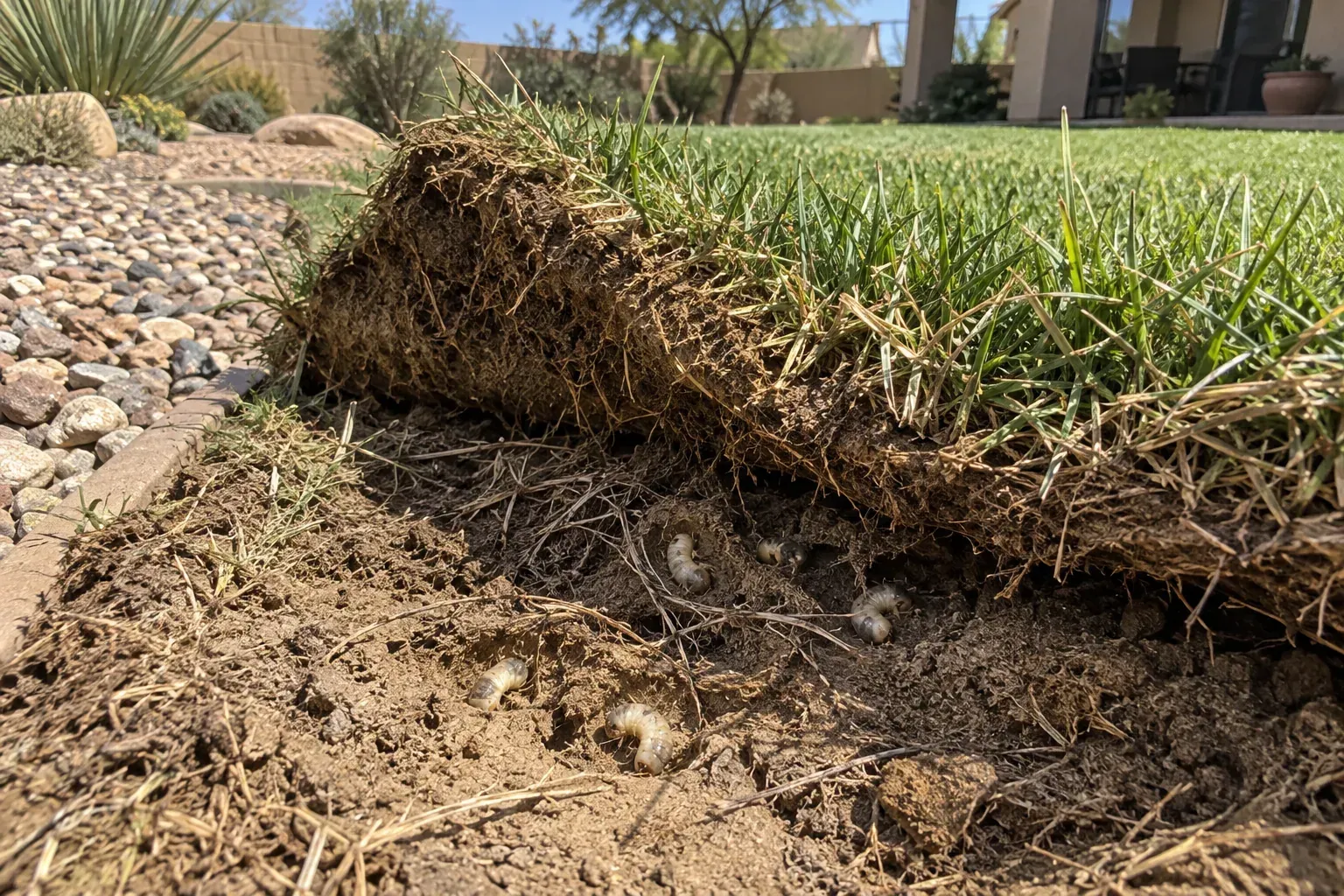
- White grubs feeding on roots in late summer, so turf lifts like loose carpet
The instinct is to water more.
That rarely fixes any of these. For salt buildup and shallow roots, watering more often makes the problem worse.
The fix starts with finding which cause you actually have.
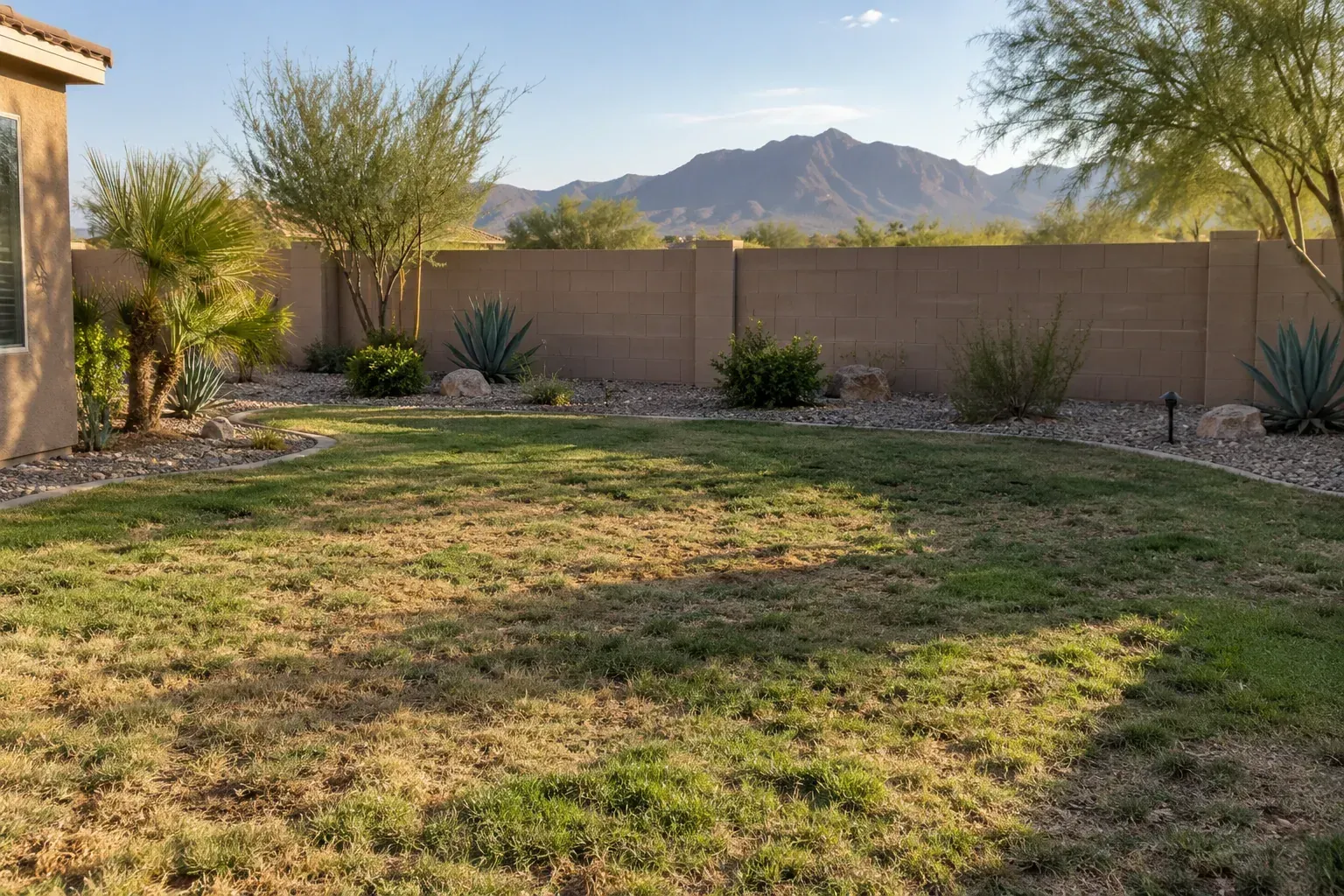
Why Summer Damage Shows Up in September
Summer stress is cumulative. It builds for months before it becomes visible.
Through June, July, and August, Bermuda survives on stored energy and a shrinking root system. When temperatures ease in September, a healthy lawn bounces back. A lawn that burned through its reserves does not.
The damage was done in July. September is simply when you can see it.
2026 made that worse than usual. National Weather Service figures for Phoenix show:
- 39 days at or above 110°F, the fourth most on record
- 29 days when the temperature never dropped below 90°F, the third most on record
- An average summer temperature of 97°F, tied for the second hottest summer on record
- Just 0.97 inches of rain from January 1 to mid-August, the second lowest total on record for that date
- 0.65 inches of monsoon rain by mid-August, against a normal 1.45 inches
Those hot nights matter as much as the hot days.
Grass recovers at night. When the low stays above 90°F, there is no recovery window, and stress stacks up day after day.
The missing rain matters too. Monsoon storms normally flush some of the salt that irrigation leaves behind in the soil. This summer, far less of that flushing happened.
First, Rule Out Dormancy
Before you diagnose anything, confirm the grass is actually dead.
Bermuda protects itself in extreme heat by slowing down and browning out. Brown is not the same as dead.
Two quick checks:
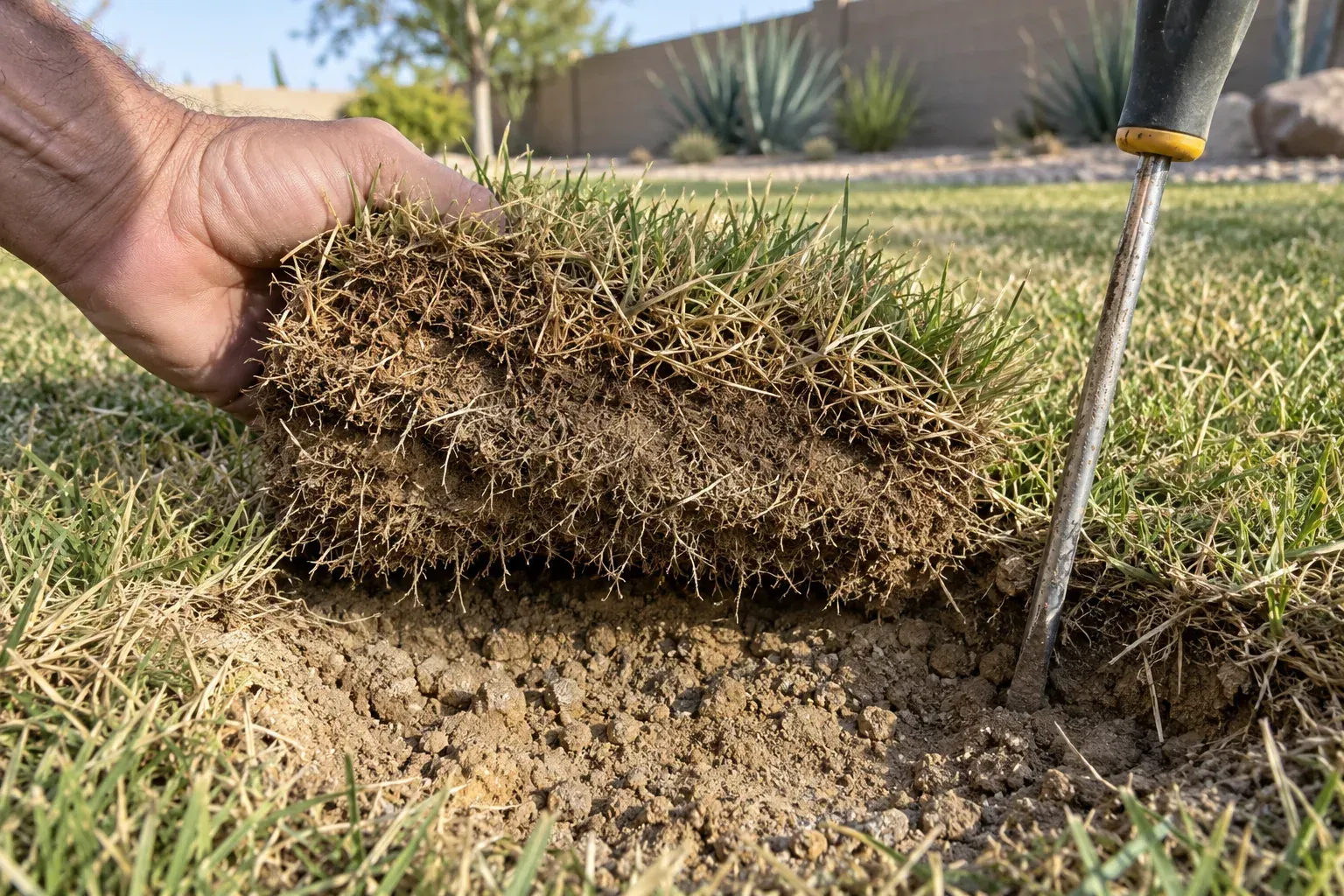
- Tug test: grab a handful and pull. Resistance means living roots. Grass that lifts like loose carpet is dead, or something has eaten the roots.
- Crown check: scratch a runner at soil level. Green or white tissue inside means it is alive.
Stressed but living Bermuda usually greens up within 2 to 4 weeks of consistent, deep watering.
The full dormant-versus-dead walkthrough is in Heat-Wave Survival Guide for Arizona Lawns & Trees (Blog 29). If whole sections failed, the repair sequence is in Emergency Fixes for Burned Lawns in Arizona (Blog 30).
This blog answers the question those two do not: why it happened, and how to stop it happening again.
The 7 Real Reasons Lawns Fail After an Arizona Summer
Each cause leaves a different pattern. Match the pattern and you usually find the cause.
1. Salt Buildup in the Root Zone
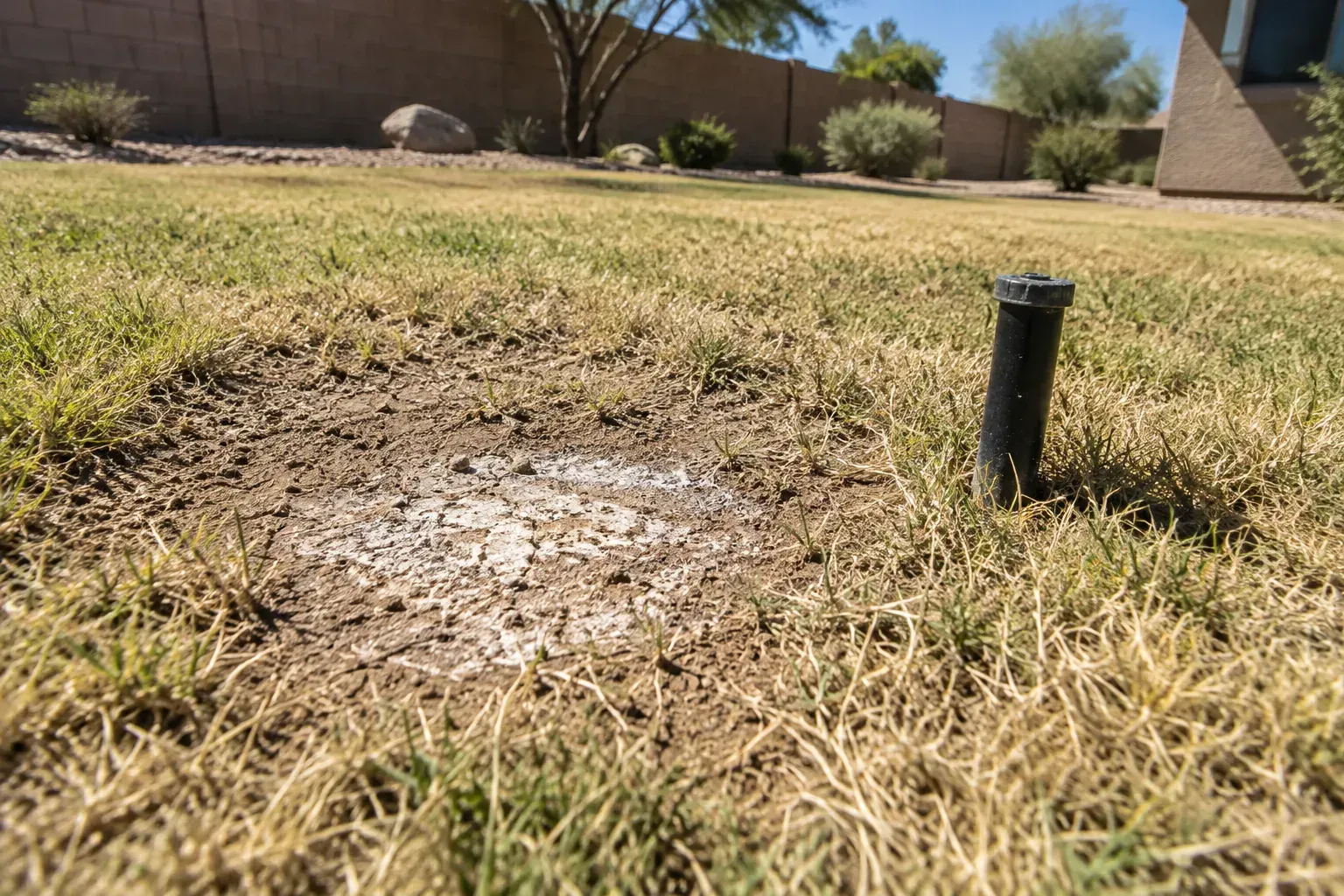
What it looks like:brown or thin areas that do not respond to extra water. Sometimes a white or gray crust forms on bare soil, especially along edges and in low spots.
Why it happens:Buckeye relies almost entirely on groundwater, which carries naturally dissolved minerals such as calcium, sodium, and magnesium. University of Arizona turf research notes that some groundwater sources exceed 1,000 ppm of total dissolved solids.
Every irrigation cycle leaves some of that salt behind when the water evaporates.
Short, frequent cycles only wet the top inch or two of soil. So the salt collects exactly where the roots are.
Bermuda is more salt tolerant than most lawn grasses. That is exactly why salt damage gets missed until it is severe.
How to confirm:the damage stays put no matter how much you water, and it is worst where water sits and evaporates instead of draining. A soil test that includes salinity confirms it.
Fix now:switch from short, frequent cycles to deep soaks that reach 6 to 8 inches down. Split each soak into two or three shorter runs with a break between them so the water sinks in instead of running off.
Prevent next year:plan a deliberate flush. University of Arizona turf research puts the extra water needed at roughly 3 to 6 inches a year for low-desert turf on lower-quality water, and notes that winter is the most efficient time to do it because evaporation is low.
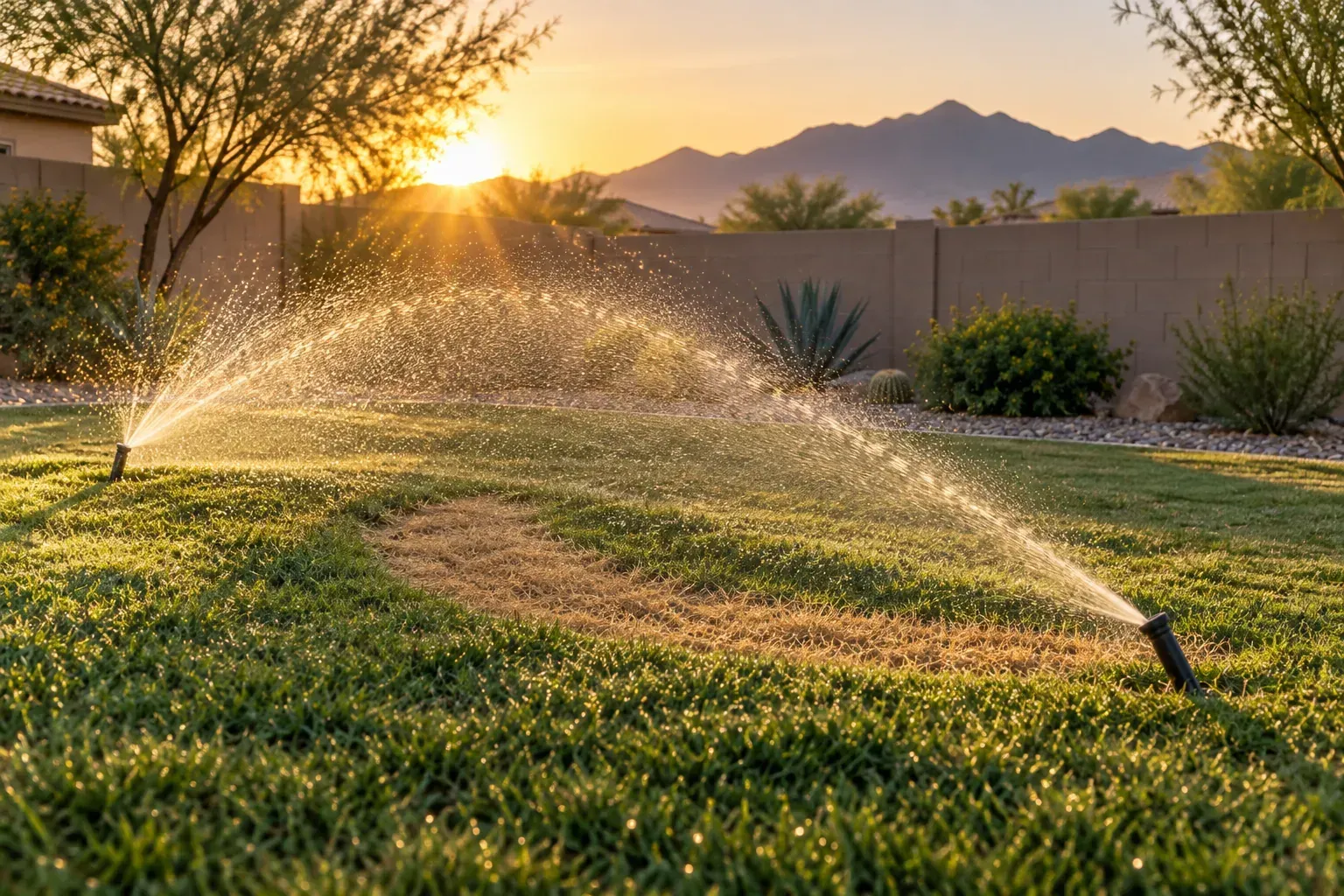
2. Sprinkler Coverage Gaps
What it looks like:dry crescents or circles between sprinkler heads, brown strips along the edges of a zone, or one corner that always fails first.
Why it happens:heads tilt, sink below grade, get clipped by mowers, or get buried as grass grows around them. Nozzles clog with the same minerals that are in the water.
Most residential systems lose 15 to 30% of their water to invisible inefficiency like this.
In a normal year, monsoon rain covers for some of these gaps. In 2026 there was very little rain to cover for them.
How to confirm:run a catch-cup test. Set identical cups or tuna cans across the zone, run it for 15 minutes, and compare the water in each. If some cups hold twice as much as others, coverage is the problem, not the schedule.
Fix now:straighten heads and raise them to grade, trim grass away from them, clean or replace clogged nozzles, and make sure every head in a zone uses the same type of nozzle.
Prevent next year:audit the system in April, before the heat, not in August after the damage. The full watering method is in Smart Irrigation Principles for Arizona Summers (Blog 27).
3. Compacted Soil
What it looks like:water runs off or puddles instead of soaking in. Grass thins along paths, play areas, gate routes, and anywhere bins or cars sit.
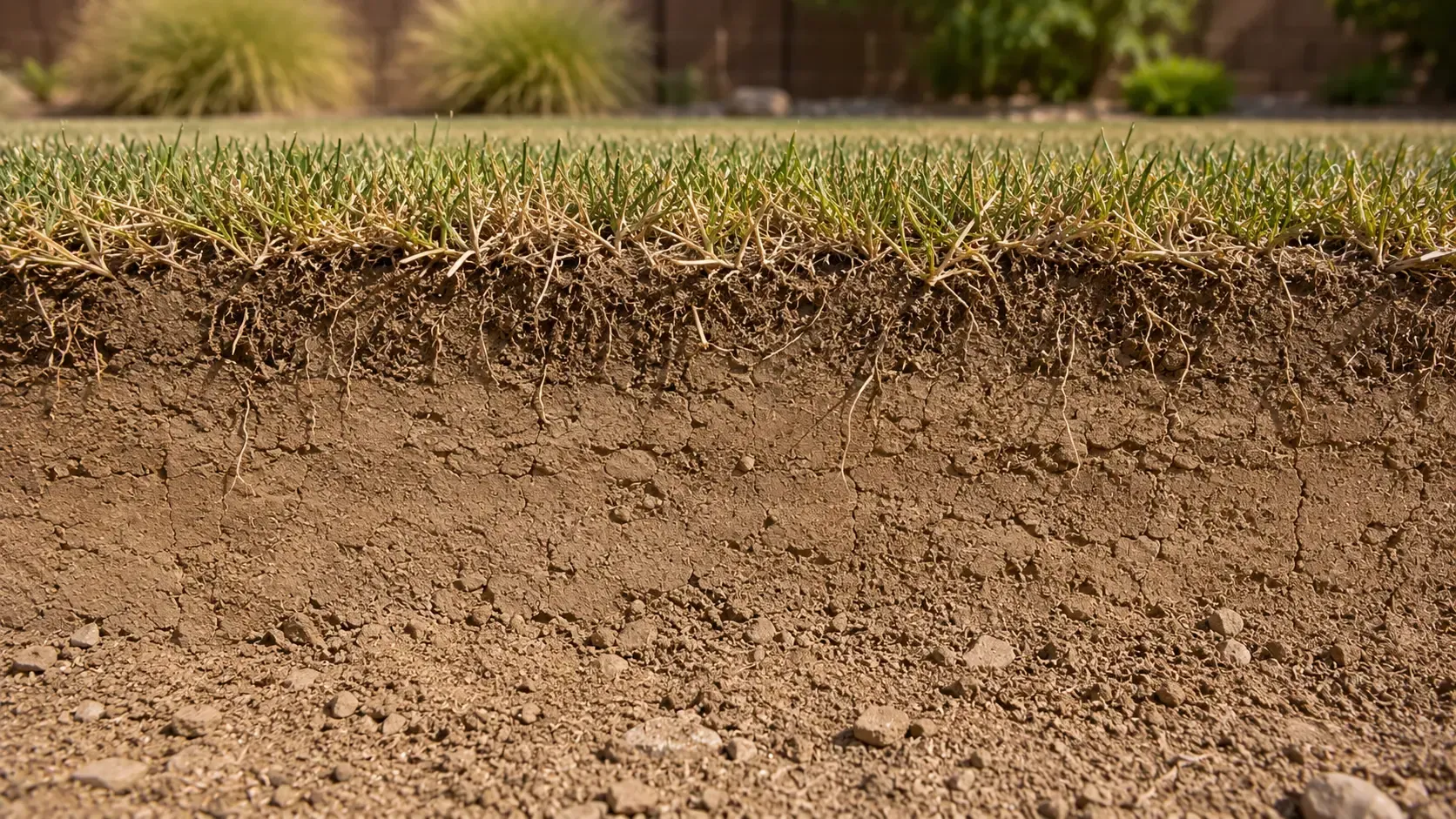
Quick check: push a long screwdriver into moist soil. If it stops within 2 to 3 inches, the soil is compacted.
Why it happens: West Valley soils are often heavy, and many Buckeye yards have caliche close to the surface. Foot traffic, mowing, and monsoon cleanup press the top layer even tighter.
Roots cannot push through it. So the lawn lives on a shallow root system, and summer heat destroys shallow roots first.
Fix now: light work only in September. Deep, slow watering helps right away.
Prevent next year: core aerate while Bermuda is actively growing. University of Arizona Extension names June, July, and August as the ideal window to aerate low-desert lawns.
The soil side of this is covered in Arizona Soil Health & Preparation
4. Thatch Buildup
What it looks like: a spongy lawn that feels soft underfoot, water that beads on the surface, and grass that browns fast between waterings.
Why it happens: Bermuda spreads by runners above and below the ground. Heavy feeding and frequent watering speed up that growth, and the layer of dead stems builds faster than it breaks down.
Water and fertilizer get trapped in that layer instead of reaching the soil. Roots move up into the thatch, where summer heat cooks them.
How to confirm: cut out a small wedge of turf. If the brown, spongy layer between the green blades and the soil is thicker than about half an inch, thatch is part of the problem.
Fix now: do not dethatch aggressively in September. Bermuda is slowing down and cannot recover from heavy work before it goes dormant.
Prevent next year: dethatch or verticut in the same June to August window as aeration, and avoid overfeeding.
5. Shade Creep
What it looks like: thin, stretched, patchy grass under or beside trees, along the north side of walls, and in narrow side yards.
Why it happens: Bermuda needs more light than any other common lawn grass. In shade it grows long, weak stems, spreads less, and builds fewer roots.
Trees that were small when the lawn went in now cast real shade. And as the sun sits lower in fall, shadows get longer, so shaded strips get worse, not better.
How to confirm: count the hours of direct sun the area gets. As a working rule, Bermuda struggles anywhere with less than about 6 hours of direct sun.
Fix now: raise the mowing height slightly in shaded areas and keep traffic off them.
Prevent next year: have a professional raise the tree canopy by removing lower limbs correctly, never by lion-tailing or topping. Or stop fighting the shade. Tree Selection & Shade Planning in Arizona (Blog 25) covers placing trees so they shade people, not turf. For spots that fail every year, 6 Best Grass Alternatives for No-Mow Lawns in Arizona (Blog 9) covers options that handle shade and heat better than Bermuda.
6. Mowing Too Low in the Heat
What it looks like: brown, stubbly patches right after mowing, scalped high spots, and a lawn that looks worse every time it is cut.
Why it happens: the leaf blade is what feeds the roots. Cut too low in 110°F weather and the grass loses its food supply and its own shade at the same time. Uneven ground makes it worse, because the mower scalps every high point.
How to confirm: check your mower height. University of Arizona turf research puts common Bermuda at roughly 1/2 to 2 inches and hybrid Bermuda at roughly 1/2 to 1 inch.
Fix now: raise the deck toward the top of your grass type's range, sharpen the blade, and never remove more than one third of the blade in a single mow.
If you are overseeding, the planned scalp in October is different. That is a controlled cut on a lawn that is already slowing down, not a summer mowing habit.
Prevent next year: set the mowing height in April and keep it there when growth speeds up in June.
7. Pests You Cannot See From the Patio
Two pests account for a lot of late-summer "mystery" damage.
Bermudagrass mites:
- Tiny mites that live under the leaf sheath
- Cause "witches' broom": short, tufted, knotted growth, followed by browning in summer
- Breed fast in heat, with a new generation every 7 to 10 days between 80°F and 110°F
- Common Bermuda is susceptible, while hybrid Bermuda varieties are more resistant
- Confirmed with a 10X to 30X hand lens on the leaf sheaths of stunted plants
White grubs:
- The larvae of masked chafer beetles, which fly to porch lights mostly from mid-June through July
- Feed on grass roots, with damage usually peaking in late summer and early fall
- Badly damaged turf rolls back like a carpet
- Birds, skunks, or other animals digging in the lawn is a common giveaway
- Up to about 6 grubs per square foot is usually tolerable in a home lawn
Do not spray on a guess. Confirm the pest first, because the wrong product wastes money and adds stress to grass that is already struggling.
The Myth That Makes It Worse: "Just Water More"
This is the most common response to a failing lawn in September, and it is usually wrong.
Watering more often feels like the safe move. Here is what it actually does:
- Concentrates salt: short, frequent cycles wet the top inch or two and leave the salt there, right in the root zone
- Keeps roots shallow: roots follow water, so shallow watering builds a lawn that cannot survive the next heat wave
- Hides the real problem: a coverage gap or a grub infestation stays in place while the water bill climbs
- Wastes water on dead turf: grass that lifts like carpet will not come back no matter how often you water
University of Arizona Extension guidance for low-desert lawns points the other way: deep, infrequent watering, roughly every 3 days in summer instead of several short runs a day.
The goal is deeper water, not more frequent water.
Deeper watering pushes salt below the root zone and pulls the roots down with it. That is what builds a lawn that survives the next summer.
Read the Pattern: A 10-Minute Lawn Diagnosis
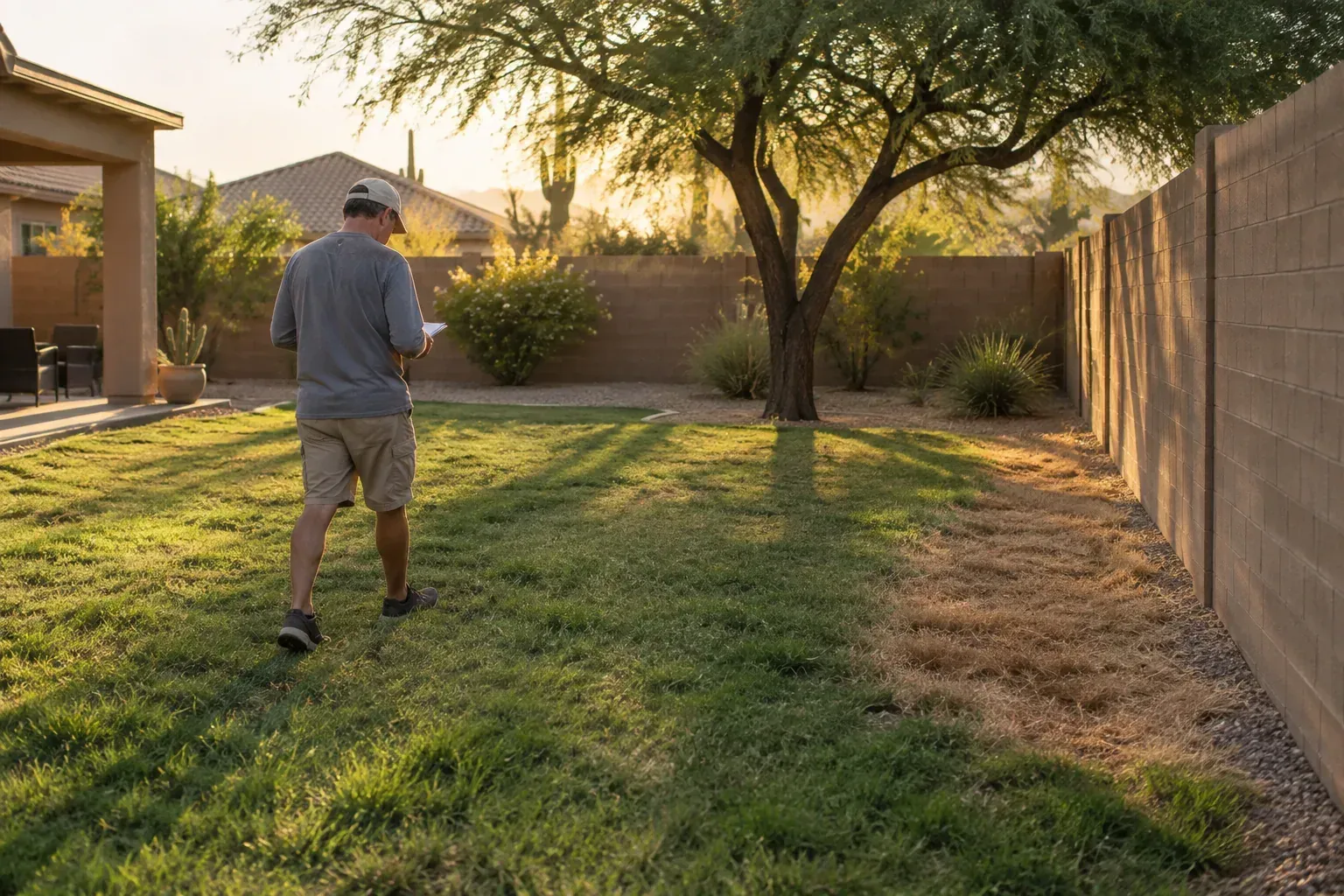
Walk the lawn with this list. The shape and location of the damage point to the cause.
- Crescents or circles between sprinkler heads: coverage gaps
- Brown strips within 2 to 4 feet of walls, driveways, and sidewalks: reflected heat, often combined with edge drying
- Narrow turf strips under 6 feet wide that fail every year: a strip too narrow to sustain grass in desert heat
- Thin, stretched grass under trees or along north-facing walls: shade
- Areas that stay brown no matter how much you water, sometimes with a white crust: salt buildup
- Water pooling or running off, and thin grass on paths and play areas: compaction
- Spongy turf that dries out fast: thatch
- Short, tufted, knotted growth: bermudagrass mites
- Turf that peels back like carpet, or animals digging: white grubs
- Stubbly brown patches right after mowing: mowing too low
- Even browning across the whole sunny lawn, with roots that hold when tugged: heat dormancy, not death
Most lawns show two or three of these at once.
Fix them in this order: water coverage first, then soil, then everything else. Nothing else works until water reaches the roots evenly.
What to Do Now, and What to Change Next Year
Now: late September
- Fix sprinkler coverage first. Every other repair depends on water reaching the soil evenly.
- Replace short cycles with deep soaks where salt or shallow roots are the issue.
- Confirm pests before treating. A hand lens for mites, a shovel for grubs.
- Leave aeration and dethatching for next summer. Bermuda is slowing and cannot recover from heavy work before dormancy.
- Decide on overseeding. If large areas failed, winter ryegrass can cover them until you rebuild the Bermuda in late spring.
Dead patches will not fill in on their own once Bermuda slows. Its growth shuts down as nights drop below about 65°F, which usually happens in early October.
The September watering schedule and the overseeding decision are covered step by step in Late-Summer Lawn Recovery in Arizona.
Next year: April to August
Most of this summer's failures were decided in spring. Change these and next September looks different:
- April: audit the irrigation system and run a catch-cup test before the heat arrives
- April to May: set the mowing height for your grass type and keep it there
- May: test the soil, including salinity, if this year's damage fits the salt pattern
- June to August: core aerate and dethatch while Bermuda is growing fastest
- All summer: water deeply and infrequently instead of in short daily cycles
- Winter: plan a deliberate deep flush to push accumulated salt below the root zone
The spring side of this list is covered in Early-Season Lawn & Tree Mistakes Arizona Homeowners Make (Blog 22). For the full year-round watering rhythm, see Seasonal Watering Guide: How to Keep Your Arizona Lawn Green Year-Round (Blog 6).
And if the same spots fail every year, the grass itself may be wrong for the spot. Best Grass for Arizona Lawns (Blog 2) compares the options by sun, water, and traffic.
When to Call a Professional
Some causes are easy to confirm yourself. Others need equipment, testing, or a trained eye.
Bring in a professional when:
- Large areas died and you cannot tell whether the cause was water, salt, pests, or soil
- The same zones fail every summer despite changes to your schedule
- Your irrigation system needs head adjustments, nozzle matching, or valve repair
- You suspect grubs or mites and want them confirmed before anything is applied
- Trees are shading the lawn and need proper canopy work, not topping or lion-tailing
- You are deciding between repairing, overseeding, resodding, or replacing turf
- You manage an HOA or commercial property where the lawn has to look right year-round
If your Buckeye lawn came out of summer thin, patchy, or dying in the same spots as last year, schedule a professional lawn assessment before the Bermuda goes dormant in October. Once growth stops, the cause gets harder to read and every fix waits until spring.
Why Finding the Real Cause Pays Off
Homeowners who diagnose before they treat consistently get:
- Lower water bills, because water goes where the roots can use it
- Deeper roots that carry the lawn through the next 110°F stretch
- No wasted money on fertilizer, pesticide, or seed the lawn cannot use
- Fewer dead patches, because the cause is fixed and not just the symptom
- A clear plan for spring instead of the same repair every September
- Better decisions about where grass belongs and where it does not
A lawn does not fail because of one bad week in July.
It fails because of a pattern nobody read.
Read it once, fix the cause, and next September looks different.
FAQ: Why Lawns Fail After Summer in Arizona
Why is my lawn dying after summer in Arizona?
Most post-summer lawn failures in Arizona come from problems the heat exposes rather than creates: salt buildup from groundwater irrigation, sprinkler coverage gaps, compacted soil, thatch, shade, mowing too low, and pests such as bermudagrass mites or white grubs. The shape and location of the damage usually point to the cause.
Why did my grass die over the summer even though I watered it?
Frequent, shallow watering keeps roots in the top few inches of soil and leaves salt concentrated where the roots are. When days stay above 110°F and nights stay above 90°F, a shallow-rooted lawn cannot keep up. Deep, infrequent watering that reaches 6 to 8 inches builds roots that survive the heat.
Is my Bermuda grass dead or dormant after summer?
Grab a handful and pull. If it resists, the roots are alive and the grass is dormant or stressed. If it lifts like loose carpet, that section is dead or grubs have eaten the roots. Living Bermuda usually greens up within 2 to 4 weeks of consistent, deep watering.
How do I know if salt is killing my lawn?
Salt damage shows up as brown or thin areas that do not improve with extra water, sometimes with a white crust on bare soil. It is common in Buckeye, where water comes almost entirely from groundwater with naturally dissolved minerals. A soil salinity test confirms it, and deep, infrequent watering plus a winter flush pushes the salt below the root zone.
Can I aerate my Arizona lawn in the fall?
For Bermuda lawns in the low desert, fall is the wrong time for heavy aeration or dethatching. University of Arizona Extension identifies June, July, and August as the ideal window, when Bermuda is growing fastest and recovers quickly. Heavy work in September or October stresses grass that is heading into dormancy.
Why does my lawn die in the same spots every year?
Repeat failures in the same place almost always have a fixed cause: a sprinkler head that under-waters the area, compacted soil, reflected heat from a wall or driveway, shade from a tree, or a strip too narrow to sustain turf. Watering the whole lawn more will not fix it. Correcting that spot's cause will.
Do grubs damage lawns in Arizona?
Yes. Masked chafer beetles fly mostly from mid-June through July, and their grubs feed on grass roots, with damage usually peaking in late summer and early fall. Badly damaged turf peels back like a carpet. Up to about 6 grubs per square foot is usually tolerable in a home lawn, so confirm the numbers before treating.
Will dead patches grow back on their own before winter?
Usually not. Bermuda spreads into thin areas while it is actively growing, but growth shuts down as nights drop below about 65°F, which typically happens in early October. Large dead areas are better covered with winter ryegrass and rebuilt properly in late spring.

Monsoon-Ready Landscaping Systems in Arizona: How to Storm-Proof Your Yard Before the First Big Wind


Why Is My Water Bill So High in Arizona? How to Stop Landscape Water Waste Before Summer Costs Spike