


What should I do first after a monsoon storm damages my trees?
Check for downed or sagging power lines before stepping into the yard. Stay at least 100 feet away and call 911 if any are present. Once electrical hazards are ruled out, look up for hanging limbs, keep everyone clear of damaged trees, and photograph the damage before any cleanup begins.
How far should I stay from a downed power line in Arizona?
At least 100 feet — roughly two semi-truck lengths — and farther in wet conditions, since water can carry current. Assume every line is live regardless of whether it is sparking or moving, and never touch anything in contact with it, including trees, vehicles, or debris.
Can a leaning tree be saved after a storm?
It depends on the root plate. If roughly 30–40% or more has lifted, the tree cannot re-root and is unsafe even while standing. A new lean combined with soil heaving at the base usually means anchorage is lost. A long-standing lean with no soil movement is a different and less urgent situation.
How much damage can a tree survive?
Most healthy trees recover from canopy damage under about 25% when the trunk and root system remain intact. Deep trunk splits, a lifted root plate, or losing roughly half the canopy generally means removal is the safer option.
Is it safe to cut storm-damaged branches myself?
Small branches already on the ground are usually manageable. Anything overhead, under tension, requiring a ladder, or near a wire is not. Storm-damaged limbs store energy and release it unpredictably when cut, which is why most cleanup injuries happen during DIY work rather than during the storm.
How do I avoid getting scammed by storm cleanup contractors?
Verify any contractor's license at roc.az.gov before agreeing to work. Get multiple estimates, insist on a written contract, never pay in full up front, and never sign under pressure. The Arizona Attorney General has specifically warned about door-to-door tree removal offers after storms.
Should I water my landscape after a monsoon storm?
Not immediately. Soil that received an inch or more of rain does not need supplemental water for several days, and restarting irrigation too soon on saturated ground risks root rot on top of existing storm stress.
The most dangerous moment after an Arizona monsoon storm is not during the storm.
It is the next morning, when homeowners walk outside to see the damage.
Here is the safety order that matters most:
- Downed or sagging power lines — stay back at least 100 feet and call 911 immediately
- Hanging limbs still in the canopy — do not stand under them or attempt removal
- Trees with a new lean or lifted soil at the base — keep everyone clear, including pets
- Standing water — assume it may be electrically charged
- Anything touching a wire — treat it as live, including trees, fences, and vehicles
Only after those hazards are ruled out does cleanup begin.
Storm damage in the Valley causes serious injuries every single monsoon season, and most of them happen during cleanup rather than during the storm itself.
The reason is straightforward: storm-damaged trees hold energy. Limbs are under tension, wood is unstable, and failures are unpredictable.
A branch that looks settled can drop hours or days later.
What Arizona Monsoon Storms Actually Do to Properties
The scale of Valley storm damage is easy to underestimate until it reaches your street.
A single August 2026 storm brought down 42 power poles across the metro and cut power to roughly 22,000 APS customers — with West Valley communities including Buckeye, Goodyear, Litchfield Park, and Glendale among the hardest hit.
Separate July 2026 storms left tens of thousands of SRP customers without power across the West Valley, East Valley, and central Phoenix.
Phoenix Parks crews respond to downed trees on cars, homes, and power lines every year, with volume spiking during monsoon.
The damage patterns repeat:
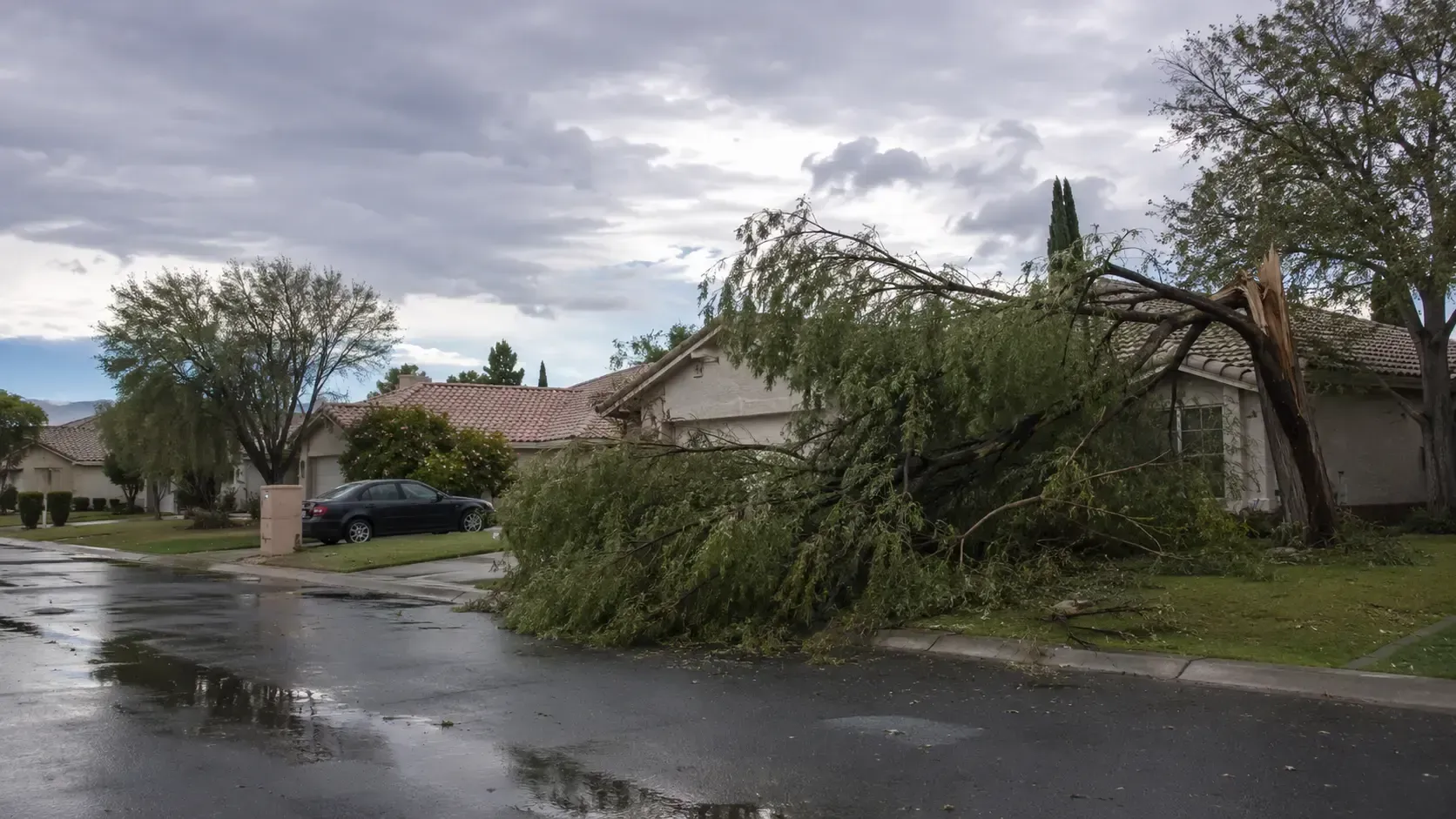
- Trees uprooted from saturated soil
- Large limbs sheared off at weak branch unions
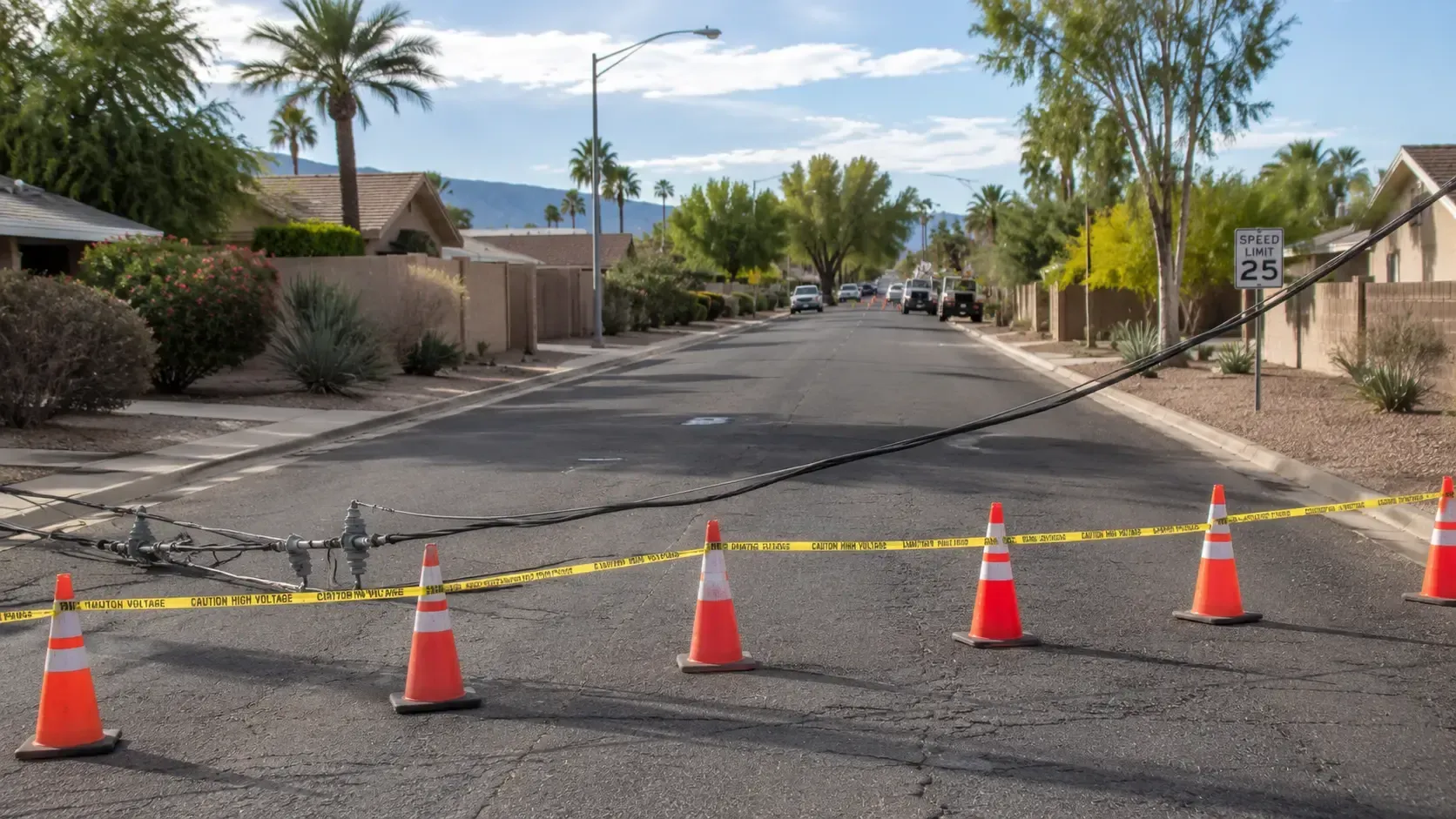
- Power poles and lines down across yards and streets
- Flooding in low spots and against foundations
- Debris scattered across properties by 60+ mph gusts
- Erosion channels cut through rock beds and decomposed granite
If your landscape came into the season unprepared, the preventive systems that reduce all of this are covered in Monsoon-Ready Landscaping Systems in Arizona (Blog 31).
But once damage has happened, the priority shifts entirely to safety.
Rule One: Electrical Hazards Come Before Everything
This is the section worth reading twice.
Stay at least 100 feet from any downed or sagging line
Fire officials across the Valley advise a minimum 100-foot distance — roughly the length of two semi-trucks.
When a live wire touches the ground, electricity spreads outward and energizes the surrounding area. You do not need to touch the wire to be injured.
Assume every line is live
You cannot tell whether a line is energized by looking at it.
A line that is not sparking, humming, or moving may still be carrying current. SRP has warned that downed or damaged lines can carry voltage vastly higher than standard household levels.
Call 911 first
SRP directs residents to call 911 when a storm knocks down or damages a wire. SRP's emergency line is 602-236-8888. APS outages can be reported at 855-688-2437.
Never touch anything in contact with a line
That includes trees, tree limbs, fences, vehicles, ladders, debris — and people.
Treat standing water as a hazard
Floodwater can be electrically charged from downed or underground lines. Avoid walking through it.
Understand why tree crews wait
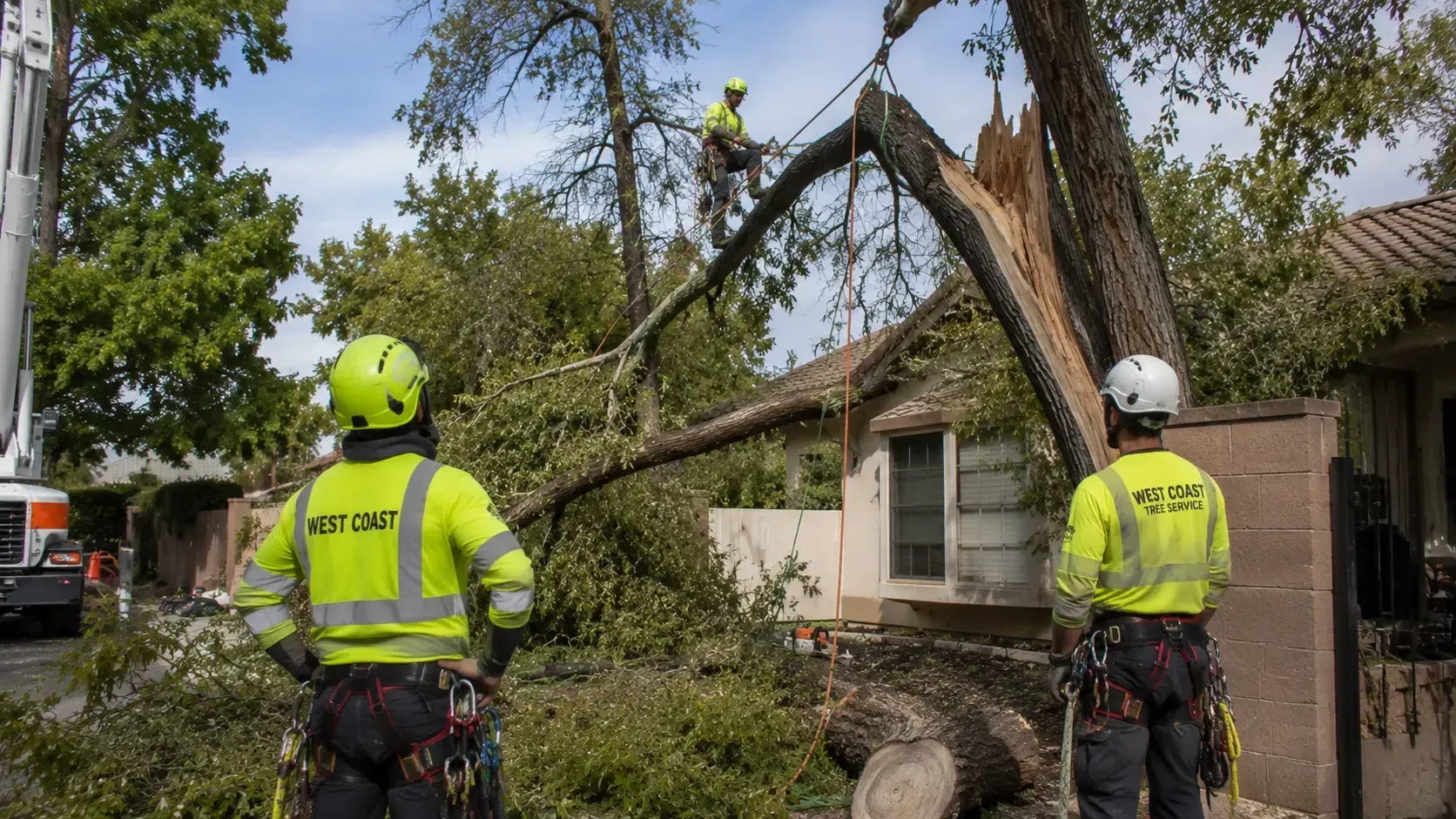
Utility representatives must confirm lines are de-energized before any tree removal crew can begin work near them.
If a company offers to start cutting a tree tangled in wires before the utility has cleared it, that is not efficiency. That is a company willing to risk a fatality on your property.
Rule Two: Identify Hazards Before You Step Into the Yard
Before touching a single branch, walk the perimeter and look up.
Hanging limbs — the biggest cleanup danger
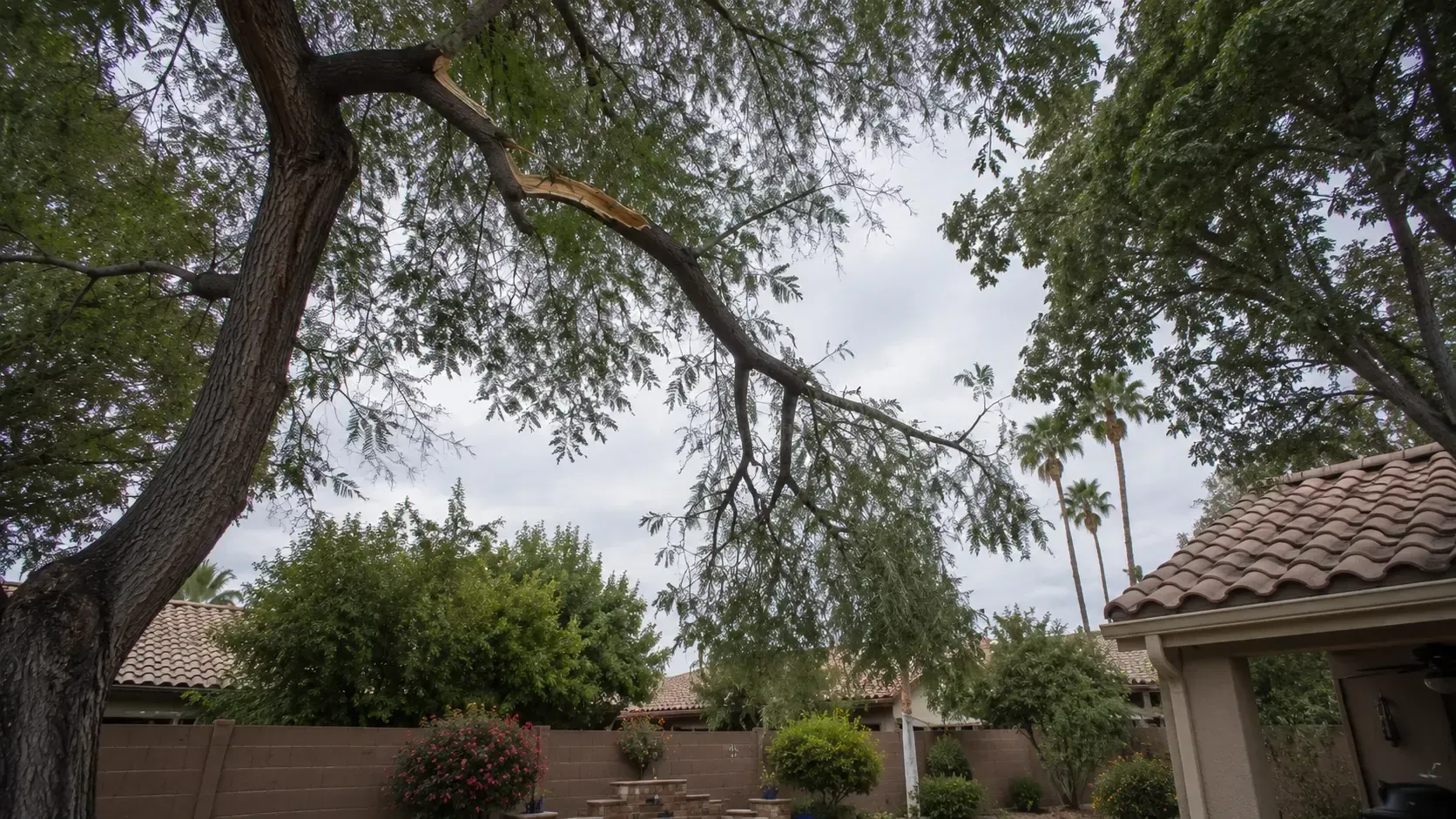
Broken limbs still lodged in a canopy are called hangers, or widowmakers.
They can fall without warning, with no trigger and no sound beforehand.
The most dangerous ones are the ones you cannot see — a limb broken deep in the crown that stays wedged for hours or days before dropping.
Do not stand under a damaged canopy. Do not attempt to knock them down.
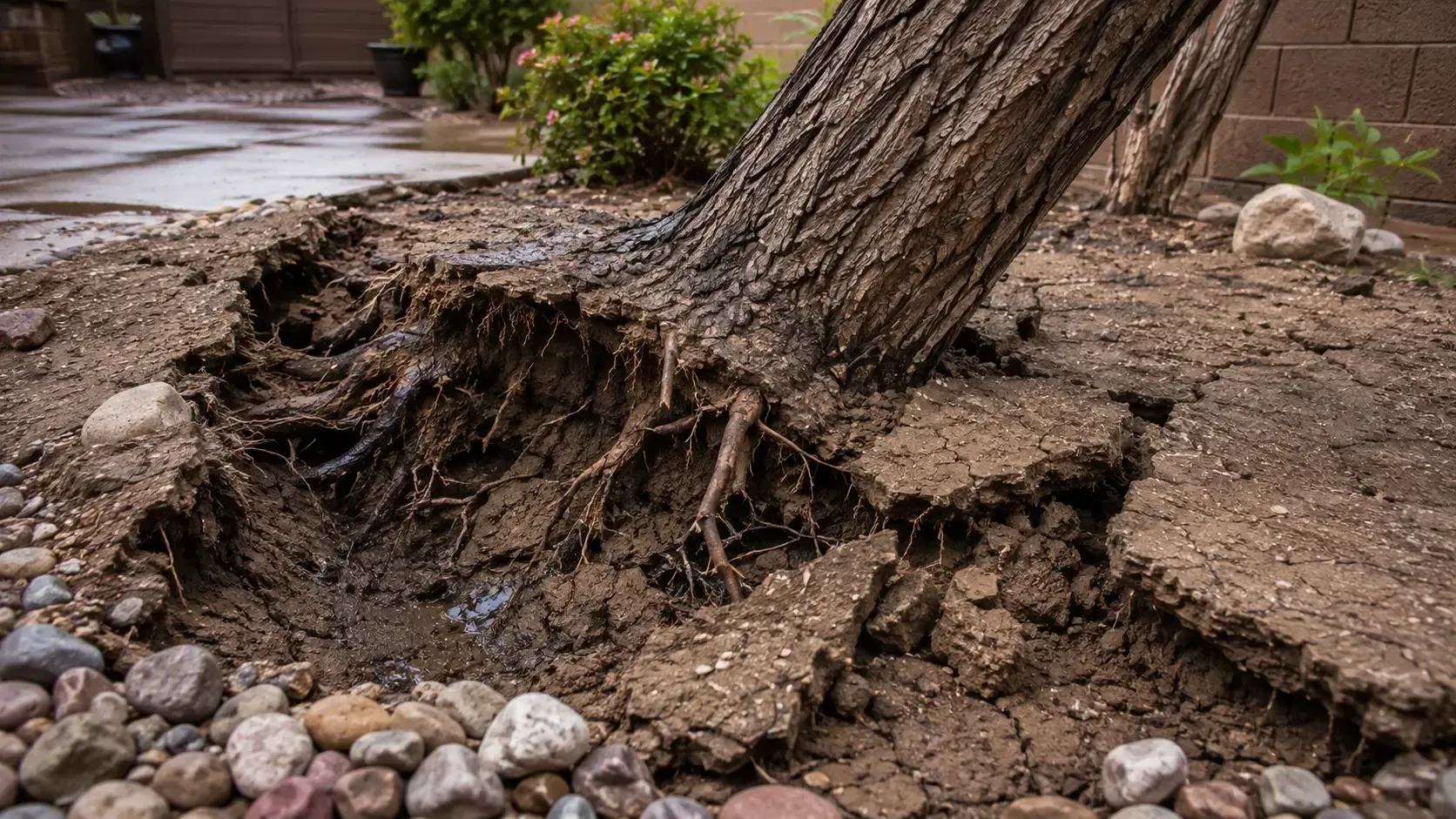
A new lean
A tree that has leaned for years is a different situation from a tree leaning today that was upright yesterday.
A sudden lean after a storm points to root failure or lost anchorage.
Soil heaving at the base
Look at the ground around the trunk. If soil is lifted, cracked, or gapping on one side, the root plate has shifted.
This is one of the most reliable indicators of a tree that is no longer safely anchored.
Trunk cracks and splits
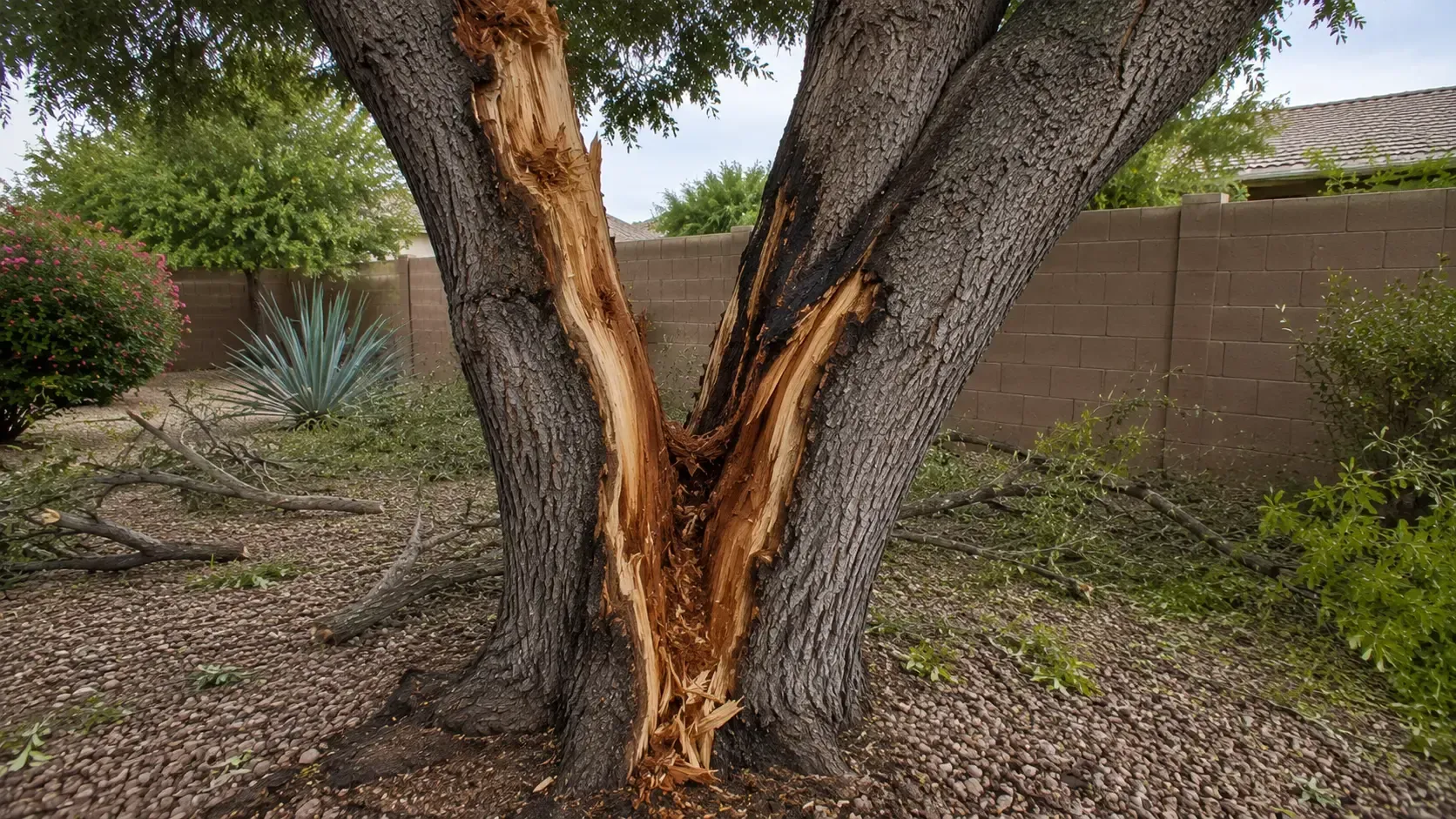
Deep cracks, splits running down the trunk, or halves peeling apart mean structural integrity is gone.
Trees held up by other trees
A partially fallen tree resting against another is under enormous unpredictable tension. Do not approach it.
Trees touching structures or vehicles
Any tree resting on a roof, wall, or car needs professional handling before anything is moved.
If any of these are present: keep people and pets well clear, rope off the area if you can do so safely from a distance, photograph from a safe vantage point, and call for a professional assessment.
Why DIY Storm Cleanup Causes So Many Injuries
Routine yard work and storm cleanup are not the same activity.
Storm-damaged wood behaves differently:
Limbs are under tension
A branch bent under load stores energy. Cutting it releases that energy unpredictably — often violently, and often toward the person holding the saw.
Damage extends beyond what you can see
Crews clearing "just the hanging pieces" routinely find additional breakage higher in the crown or fracture lines running deeper than the visible damage.
Ladder and chainsaw combinations
Climbing a ladder with a chainsaw is where a large share of storm cleanup injuries occur. There is no safe way to do this without training and proper equipment.
Pulling leaning trees upright
Attempting to winch or pull a leaning tree upright with a vehicle is dangerous and does not restore anchorage. A shifted root plate does not self-correct.
Saturated ground
Soil that is still soft after heavy rain means an already-compromised tree can shift further while someone is working near or under it.
What is reasonable to handle yourself: small branches on the ground, light debris, clearing drainage paths, and documentation.
What is not: anything overhead, anything under tension, anything near a wire, anything requiring a ladder, and any tree showing structural damage.
Can the Tree Be Saved? Assessment Thresholds
Not every damaged tree needs removal. Knowing the difference prevents both unnecessary removals and dangerous decisions to keep an unsafe tree.
Likely recoverable
- Canopy damage under about 25% — most healthy trees with an intact trunk and root system recover from this with proper corrective pruning.
- Broken branches with the trunk sound — clean cuts made just outside the branch collar allow the tree to seal naturally. Flush cuts and wound paint are not recommended.
- Damage confined to limbs where the trunk and root plate remain stable.
Likely requires removal
- Root plate lifted 30–40% or more — the tree cannot re-root, and it is unsafe even while still standing.
- Deep trunk splits or a split running well down the main stem.
- Roughly half the canopy gone — a sheared canopy leaves the tree structurally unbalanced.
- New lean toward a structure, driveway, walkway, or power line.
- Pre-existing decay now combined with fresh storm damage.
The judgment call
Shallow, one-sided branch splits can sometimes be stabilized with cabling or bracing by a qualified professional.
The determining factor is always structural integrity — not how the tree looks or how much foliage remains.
Do not top a damaged tree
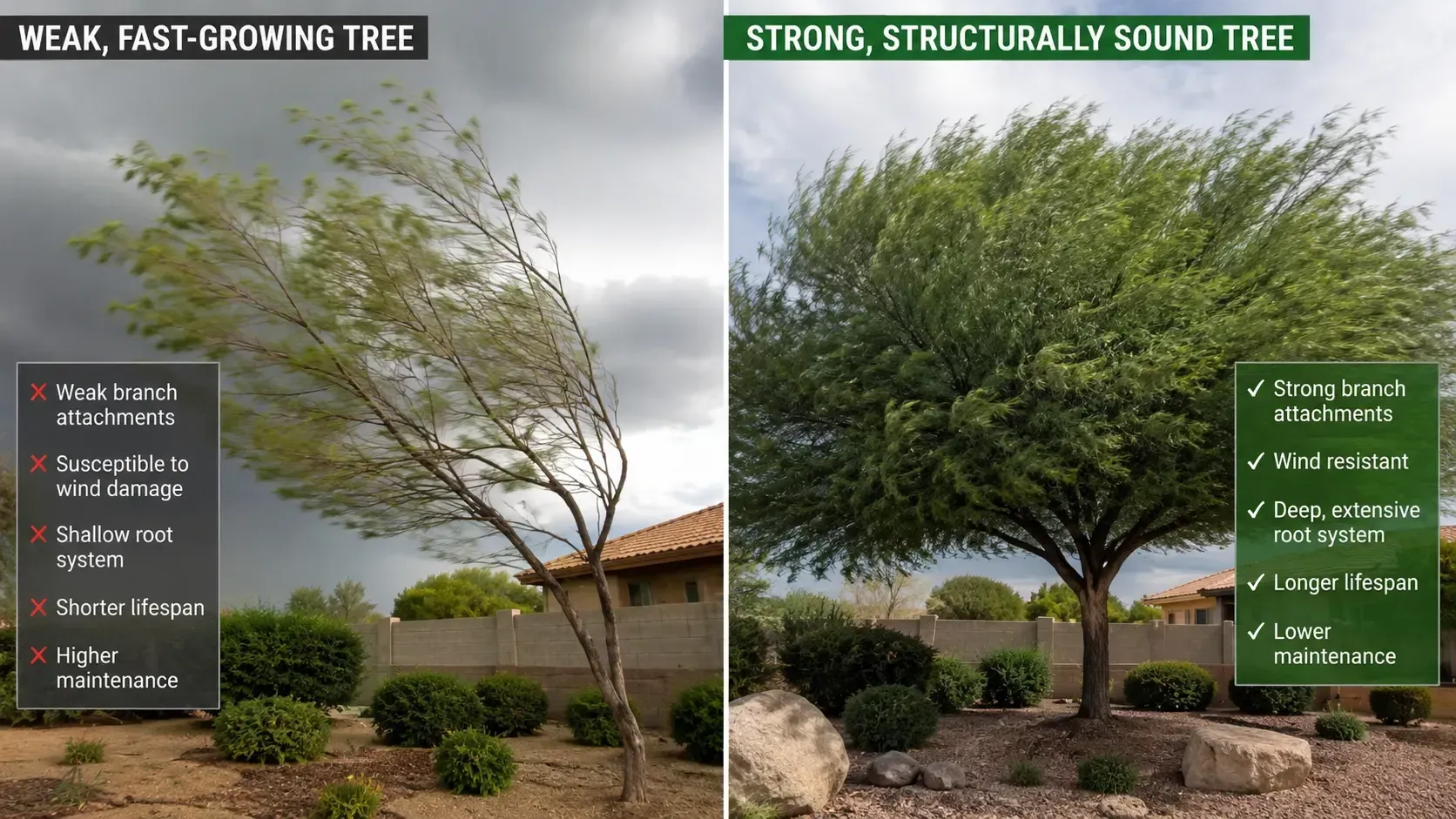
Cutting a storm-damaged tree back to stubs creates weak, fast-growing sprouts that fail in future storms and strips the tree of the leaf area it needs to recover.
This is the same mistake covered in the pruning section of Monsoon-Ready Landscaping Systems (Blog 31) — and it is even more damaging on an already-stressed tree.
Protect Yourself From Post-Storm Contractor Fraud
This is the risk most Buckeye homeowners are least prepared for.
The Arizona Attorney General's Office has issued formal consumer alerts warning residents about after-storm fraud — specifically naming door-to-door offers for tree removal and cleanup services.
How the scam works
Within 24 to 48 hours of a storm, crews with out-of-state plates work affected neighborhoods. Someone knocks, says they noticed damage from the street, and offers a fast, cheap fix.
They collect a large deposit, then either disappear or send an unlicensed crew.
These operators are known as storm chasers, and they move on to the next market within weeks — leaving no recourse if the work is defective or the deposit is gone.
How to protect yourself
- Verify the ROC license. Arizona law requires most contractors to be licensed through the Arizona Registrar of Contractors. You can confirm a license is valid and check for complaints at roc.az.gov in about two minutes.
- Get multiple estimates. Compare before committing to anything.
- Never sign under pressure. Legitimate companies do not require an immediate signature.
- Get everything in writing. Scope of work, cost, and timeline.
- Never pay in full up front. A reasonable deposit is normal. Full payment before completed work is not.
- Confirm insurance. If an uninsured worker is injured on your property, you may be exposed to the liability.
- Talk to your insurer first before authorizing significant work.
The liability point deserves emphasis
An unlicensed contractor almost certainly does not carry the insurance that protects you. A serious injury during tree work on your property becomes your problem, not theirs.
If someone knocks on your door unsolicited after a storm and pressures you toward a same-day signature, that alone is reason to decline and call a local licensed company instead.
Documentation and Insurance
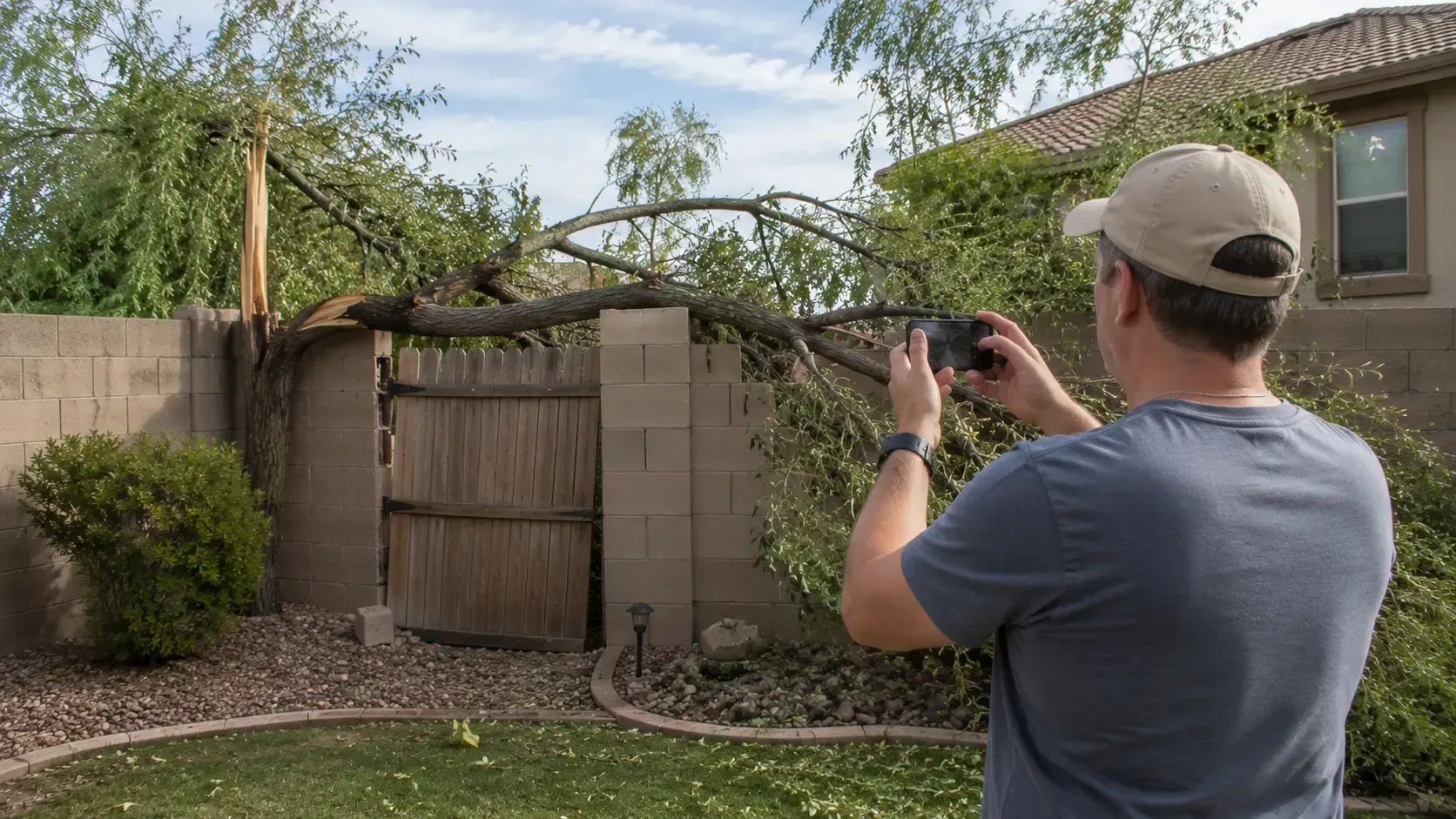
Before cleanup begins — once the area is confirmed safe — document everything.
- Photograph all damage from multiple angles
- Capture wide shots showing context and close shots showing detail
- Photograph damage to structures, vehicles, fences, and walls
- Note the date and time
- Keep receipts for any emergency work
- Contact your insurance provider before authorizing major work
- Request a written inspection report with photos from any contractor claiming damage
City of Phoenix monsoon guidance specifically advises photographing property damage for insurance purposes before cleanup.
Debris removed before it is documented is difficult to claim later.
The First 48 Hours: A Safe Sequence
Immediately
- Check for downed or sagging lines — call 911 if present
- Keep everyone, including pets, away from damaged trees
- Avoid standing water
- Do not enter any area where a tree contacts a structure or wire
Once hazards are confirmed clear
- Walk the perimeter and look up before walking under anything
- Photograph all damage
- Identify hanging limbs, new leans, and soil heaving
- Rope off unsafe areas from a safe distance
- Contact your insurer
Within the first days
- Schedule a professional assessment for any structurally damaged tree
- Clear small ground debris and drainage paths
- Check for flooding against the foundation
- Inspect irrigation for damage before restarting
- Hold off on watering — saturated soil needs no supplemental water for several days
In the following weeks
- Water deeply during dry stretches to support recovery
- Maintain 2 to 3 inches of mulch, kept off the trunk
- Do not fertilize immediately after damage
- Watch for delayed decline — some trees reveal internal damage weeks later
- Address drainage failures the storm exposed
The irrigation restart timing matters more than people expect. Resuming a normal schedule on saturated soil creates root rot on top of storm stress. The seasonal framework is in Smart Irrigation Principles for Arizona Summers (Blog 27).
Damage That Shows Up Later
Not all storm damage is visible immediately.
Watch for these over the following weeks and months:
- Sudden leaf drop or canopy thinning
- Branch dieback progressing inward from the tips
- A lean that gradually increases
- New soil cracking at the base
- Fungal growth at the trunk or root flare
- Limbs failing in later, milder wind
Some trees show stress within days. Others take weeks or months to reveal how deep the internal damage runs.
A tree that survived the storm may still need removal afterward — and a tree damaged in July can fail in a September storm that would not have troubled it before.
The trees showing heat stress before the storm are the most vulnerable to this delayed decline. That symptom checklist is in Heat Stress Signs in Arizona Lawns & Plants (Blog 26).
When to Call a Professional Immediately
Do not attempt to assess or clear these yourself:
- Any tree or debris in contact with a power line
- Hanging limbs anywhere in a canopy
- A tree with a new lean
- Visible soil heaving or a lifted root plate
- Deep trunk cracks or splits
- A tree resting on a structure, vehicle, or another tree
- Any damage requiring overhead cutting or ladder work
- Trees near the house, driveway, or areas where people walk
Storm-damaged trees require trained crews, proper rigging, and insured equipment. Hidden tension and unstable wood make outcomes genuinely unpredictable, even for experienced homeowners.
If a monsoon storm has damaged trees on your Buckeye property, schedule a professional storm damage assessment before anyone attempts cleanup. A licensed local evaluation tells you what can be saved, what has to come down, and what is dangerous to approach — and it protects you from the out-of-state crews working the neighborhood.
Reducing Risk Before the Next Storm
Monsoon season runs through September 30, and a damaged landscape faces every remaining storm in a weakened state.
The properties that come through the rest of the season intact take these steps now:
- Remove or stabilize compromised trees rather than waiting
- Properly prune damaged canopies — without topping or lion-tailing
- Repair drainage failures the storm exposed
- Restore eroded areas and mulch depth
- Address any tree already leaning or showing root movement
- Fix irrigation damage before it causes secondary problems
A tree that barely held through one storm rarely holds through the next.
The single most valuable thing a storm does is show you exactly where your landscape is weak. Acting on that information before the next storm is what separates a one-time repair from an annual expense.
FAQ: Storm Damage & Landscape Safety in Arizona
What should I do first after a monsoon storm damages my trees?
Check for downed or sagging power lines before stepping into the yard. Stay at least 100 feet away and call 911 if any are present. Once electrical hazards are ruled out, look up for hanging limbs, keep everyone clear of damaged trees, and photograph the damage before any cleanup begins.
How far should I stay from a downed power line in Arizona?
At least 100 feet — roughly two semi-truck lengths — and farther in wet conditions, since water can carry current. Assume every line is live regardless of whether it is sparking or moving, and never touch anything in contact with it, including trees, vehicles, or debris.
Can a leaning tree be saved after a storm?
It depends on the root plate. If roughly 30–40% or more has lifted, the tree cannot re-root and is unsafe even while standing. A new lean combined with soil heaving at the base usually means anchorage is lost. A long-standing lean with no soil movement is a different and less urgent situation.
How much damage can a tree survive?
Most healthy trees recover from canopy damage under about 25% when the trunk and root system remain intact. Deep trunk splits, a lifted root plate, or losing roughly half the canopy generally means removal is the safer option.
Is it safe to cut storm-damaged branches myself?
Small branches already on the ground are usually manageable. Anything overhead, under tension, requiring a ladder, or near a wire is not. Storm-damaged limbs store energy and release it unpredictably when cut, which is why most cleanup injuries happen during DIY work rather than during the storm.
How do I avoid getting scammed by storm cleanup contractors?
Verify any contractor's license at roc.az.gov before agreeing to work. Get multiple estimates, insist on a written contract, never pay in full up front, and never sign under pressure. The Arizona Attorney General has specifically warned about door-to-door tree removal offers after storms.
Should I water my landscape after a monsoon storm?
Not immediately. Soil that received an inch or more of rain does not need supplemental water for several days, and restarting irrigation too soon on saturated ground risks root rot on top of existing storm stress.


Monsoon-Ready Landscaping Systems in Arizona: How to Storm-Proof Your Yard Before the First Big Wind

Why Is My Water Bill So High in Arizona? How to Stop Landscape Water Waste Before Summer Costs Spike

Tree Selection & Shade Planning in Arizona: How to Choose the Right Trees Before Summer Heat Arrives